Category: Uncategorized

The Synagogue Protests Across the Country, Mamdani’s Response, and How to Ensure Constitutional Rights for All

On November 19, 200 protesters gathered outside the Park East Synagogue, which was hosting an event by a Jewish organization, Nefesh B’nefesh, dedicated to helping Jews immigrate to Israel. Anti-Israel protesters chanted slogans like “Death to the IDF [the Israeli army]” and “globalize the intifada.”  The latter phrase, “globalize the intifada,” could refer to a non-violent uprising of Palestinians against Israeli policies, occupation, or existence, but is often associated with the Second Intifada, a wave of attacks on Israeli civilians in the early 2000s that left over 1,000 men, women, and children dead.

Perhaps signaling the intent of this “No Settlers on Stolen Land” protest, someone described as an organizer shouted, “[i]t is our duty to make them think twice before holding these events. . . . We need to make them scared! We need to make them scared! We need to make them scared.”  The crowd amplified these statements by repeating them.

New York City Mayor-elect Zohran Mamdani’s spokesperson responded to the event by saying, “[t]he mayor-elect has discouraged the language used at last night’s protest and will continue to do so. He believes every New Yorker should be free to enter a house of worship without intimidation, and that these sacred spaces should not be used to promote activities in violation of international law.”

After examining this potential clash of free speech interests, I have concluded that: (1) the events inside the synagogue were clearly protected by freedom of speech, if not freedom of religion, (2) the anti-Israel protesters may also have been exercising their free speech rights, although they were closer to the line of unprotected incitement or threats, and their blocking of the synagogue entrance is not free speech, and (3) Mayor-elect Mamdani’s initial response undermines the reasons for the First Amendment  — that everyone deserves free speech and freedom to worship, regardless of their views.

First, those inside the Park East synagogue were engaging in First Amendment activity. Communicating about immigration to Israel is protected speech.  The organization, Nefesh B’nefesh, has no ties to any Israeli settlements in the West Bank. The organization helps with the logistics of Jews seeking, for safety or religious reasons, to move to Israel, which is legal under both United States and international law. Nefesh B’nefesh has previously showcased West Bank settlements, but does not assign anyone to a particular area within Israel.

Mamdani’s spokesperson later clarified that, by violations of international law, Mamdani meant promoting illegal settlements in the West Bank, but Nefesh b’Nefesh helps Jews generally move to Israel.

The United States and Israel do not consider West Bank settlements illegal under international law, although most of the world does. However, even advocacy for committing crimes, for example, doing illegal drugs, is still considered free speech unless it rises to the level of incitement, directed at and reasonably likely to produce imminent lawless action. The speech at the synagogue does not meet this incitement standard.

The protesters outside of the event are also permitted to peacefully express their dissatisfaction with the event. Chants of “Death to the IDF,” or “globalize the intifada,” however concerning, are protected speech in some contexts. However, these chants may rise to the level of incitement or true threats. Communications designed to make reasonable people fear imminent harm or incite violence can be punished, as with the organizers of the violent Unite the Right rally, who were charged with traveling across state lines with intent (a) to incite a riot, (b) to organize, promote, encourage, participate in, and carry on in a riot, and (c) as having ‘participated in violent encounters. . . .” 

In addition, protesters blocked the entrance, so that worshippers could not enter or exit. That is not an exercise of free speech.  New York Police Department Commissioner Jessica Tisch issued an apology to the congregants for the NYPD’s not doing a better job keeping the entrance clear.

Because the event at the synagogue was protected speech, the police have an obligation to protect those wanting to attend the event. Police cannot shut down speech because others may react to speech with violence. In fact, that would be an instance of the “heckler’s veto,” allowing angry mobs to decide who is permitted to exercise their free speech rights. The heckler’s veto is anathema to a healthy operation of the First Amendment. Chants designed to make people afraid of exercising their free speech rights should, for the same reason, be discouraged.

The rabbi at Park East Synagogue, Rabbi Arthur Schneier, watched his synagogue burn in 1938 as a child during Kristallnacht, a period when the Nazi-German government burned or vandalized over 1,000 synagogues and Jewish-owned businesses. He is a Holocaust survivor. Populist movements designed to demonize Jews and make them afraid of their identity are not hypothetical to him or his congregants. 

Worldwide, synagogues have become targets.  Within the last few weeks, arrests were made outside of a protest in Los Angeles for vandalism and assault at a pro-Palestine protest that included hateful language, a synagogue memorial in Rome dedicated to a 2-year-old child killed in a synagogue attack in 1982 was defaced after a pro-Palestine protest, and a few weeks ago, the rabbi at a synagogue in Canada spoke out after the synagogue was defaced for the tenth time.  Vandalism, assault, and blocking entrances are not free speech.

Mamdani is correct that federal and New York Law prohibits those seeking to obstruct or intimidate people exercising their rights in a place of worship. Besides free speech activity, there are freedom of religion elements, even when synagogue events relate to Israel. The connection to Israel is central in many practices of Judaism, which comes from the region of Judea, the ancient homeland of the Jews. For example, the Shema, a sacred prayer originating in 1300 BC, has worshippers saying in Hebrew, “hear o’Israel, Adonai is your God, Adonai is one.” Not all Jews support Israel’s policies or even its existence, but there is a longstanding connection, both genetically and religiously, of Jews to the land of Israel.  Jews – including Ashkenazi and Mizrahi Jews – and later Palestinians both have indigenous ties to the Levant.

Several days later, after backlash from some in the Jewish community, Mamdani said “[w]e will protect New Yorkers’ First Amendment rights while making it clear that nothing can justify calling for ‘death’ to anyone.”  It is ambiguous whose First Amendment rights he is talking about here. Mamdani seems to be referring to the protesters’ speech here, as he wants to secure their right to protest while also condemning their hateful language.  Mamdani is in a difficult position on that front, as he is often asked to condemn violent or hateful language that may also be protected speech.

Mamdani’s implication that the synagogue was promoting activities in violation of international law is immaterial. The Mayor-elect must respect the constitutional rights of all New Yorkers. The Constitution, and secondarily federal law, are the supreme law of the United States, not Mamdani’s perception of international law.

What city leaders should be doing is noting that everyone deserves their free speech rights. No one is permitted to intimidate others out of assembling or exercising their own rights, whether leaders agree with them or not.  Two out of every three Jewish New Yorkers voted for Cuomo or Silwa over Mamdani, and one third voted for Mamdani, likely in part because of Mamdani’s rhetoric that employs double standards in ways that many Jews perceive as harmful, but Mamdani must support the free speech rights of all New Yorkers equally. He has stated that he will do so.     

Criticism of Israel or its government is protected speech, and there must be breathing room to criticize any country, government, or institution.  But that criticism cannot shield intended violence or intimidation that prevents others from also exercising their protected opinions and free speech rights. In order to preserve our robust freedoms, federal and state officials must take a principled stance to free speech rights, regardless of who is exercising them.

Academic Freedom Undermined

My latest paper is up, forthcoming in the Maryland Law Review Online

Download the paper here: https://papers.ssrn.com/sol3/papers.cfm?abstract_id=5393356

Here is the abstract: Academic freedom is both a constitutional right and a professional value that belongs to professors, students, and institutions.  These various dimensions of academic freedom may conflict with each other and with democratic will outside of the institution.  Resolving these conflicts must begin with an understanding of what it means to be academic. Views differ on what belongs in the academic enterprise, but the pursuit of truth and knowledge must be fundamental to any definition of what is academic.  The open-minded search for descriptive or philosophical understanding separates academics from other ideological groups, journalists, politicians, or others who do not merit academic freedom.  

Currently, threats to academic freedom from across the political spectrum are distorting the classroom environment, altering the scholarship produced by professors, and leaving students unexposed to the process of true academic inquiry. As a current example, attempts to both foster and dismantle policies related to diversity, equity, and inclusion by institutions and by the Biden and Trump administrations have placed universities in a partisan battle that threatens their legitimacy.  Restoring this legitimacy requires prioritizing values related to process-based intellectual exploration and negotiating the difference between protected speech and unprotected conduct. 

Huda Beauty, Sephora, and the Betrayal of Inclusivity Culture

Here is a quote by Huda Kattan, creator of Huda Beauty, in a video posted to her millions of followers.  TikTok says it took down the video for spreading harmful misinformation, although Huda says she took the video down herself because it was being misconstrued.

“All of the conspiracy theories coming out and a lot of evidence behind them — that Israel has been behind World War I, World War II, September 11, October 7 — they allowed all of this stuff to happen. Is this crazy?  Like, I had a feeling — I was like, ‘Are they behind every world war?’ Yes.”

(This goes on.)

Huda’s follow-up video claimed that she was being smeared due to her activism supporting Palestine. Neutral sources, like cosmetics blogs, are omitting what she said in the original video when discussing the issue.

Every country should be criticized, without fear of government reprisal, if you disagree with its policies or actions.  That is our First Amendment right in this country, and it is one of our most precious, and most exceptional, rights. But why are we allowing people to disguise hate as activism and profit off it by using private businesses who claim to value inclusivity?

What did Huda mean in claiming that Israel is behind WW2, where millions of Jews were systematically exterminated in countries across Europe. Jews living in Israel (which wasn’t an official state at the time) did fight in WW2 for the Allies, against the Nazis.

Jews in America were also committed to fighting the Nazis. My great-uncle, who is American, helped liberate Auschwitz. My grandfather fought in Normandy. They both received Purple Hearts for being wounded as soldiers.

And what did Huda mean that the state of Israel was behind WW1? The modern state of Israel did not exist, and accusing Jews of instigating WW1 is straight Nazi propaganda, and was in Hamas’s original 1988 Charter, which also contained tenets about killing all Jews, everywhere.

The idea that Israel or Jews were behind 9/11 is a globally repeated and false anti-Semitic conspiracy theory. The terrorist group Al Qaeda took full responsibility for the attacks, killing many Jews who worked in NYC. There is no evidence that anyone else is responsible besides Al Qaeda.

And, of course, blaming Israel for 10/7 is what people say to excuse the horrors filmed gleefully by so many who poured into Israel to murder families in their pajamas and take over 200 hostages (including children).  There are still hostages alive in Gaza now; Hamas has filmed some of them in order to make more propaganda and psychologically torture their families.

Whatever your views on Israel/Palestine, it’s alarming that Huda’s claims need to be disputed. So many people are still supporting her. Supporting Palestine in its fight for freedom cannot mean parroting dangerous anti-Semitic tropes or attempting to rewrite history.

Huda Beauty promotes inclusivity as part of its brand. Inclusivity culture is quite profitable, as is Huda Beauty.

Sephora, the popular beauty retailer that sells Huda Beauty, has been asked to drop Huda Beauty from its shelves. Sephora has ended relationships with other beauty brands for misconduct, including Olivia Jade. Sephora is now reviewing its relationship with Huda Beauty, but it is unclear why Sephora needs a multi-day investigation to suss out that Israel is not behind the Holocaust.

Sephora, which sells Huda Beauty, also prides itself on inclusivity, either because inclusivity culture is profitable or Sephora cares about the concept as a principle. Right now, Sephora seems to be putting profits over principles, as Huda, across her platforms, has many more followers than there are Jews in the world. Huda Kattan has not corrected her misstatements.

Inclusivity as a principle is a laudable goal. If you truly believe in inclusivity, in a principled not a partisan way, it means appreciating beauty in so many people. It means allowing many different voices to share their experiences, to be part of something, to care about and find the truth by making spaces welcoming to people of different backgrounds and perspectives. It is the sentiment behind Grutter (since overturned) that allowed universities to maintain affirmative action programs against equal protection challenges because diversity was an important goal in the classroom.

We learn better when exposed to different types of people. As a free speech scholar, I fully support this vision of inclusivity.

Inclusivity culture in practice is too often the opposite of how it should be in theory. Of course, some people still favor principle over ideology, but many who preach inclusivity rhetoric promote acceptance of their favored groups at the expense of other groups.

Many (not all) involved in inclusivity rhetoric also don’t care about truth – they begin with a particular ideology and then cherry-pick facts to fit that narrative. It’s been hard to watch people who profess tolerance twist themselves into hypocritical knots to justify the gross generalizations they make about anyone not in their preferred ingroups.

It is difficult to draw lines. Too much censorship happens when we claim that certain views are bigoted. We need to allow a wide range of views to be discussed so we can all be enlightened by different perspectives. But there are views that seem intolerant, and then there are false statements of fact that malign entire groups. And while we also have our First Amendment rights to utter those false statements, because the government cannot be trusted to fairly and accurately determine which accounts are sufficiently true or false, we as private individuals do not need to accept conspiracy theories and lies. These are the enemy of truth and enlightenment, and inclusivity.

Sephora has every right to keep Huda Beauty on its shelves.  That is part of the freedom we cherish. But if people profiting from messages of inclusivity promote millionaires parroting literal Nazi talking points, then inclusivity culture has fully jumped the shark.

Deporting People for Pure Speech is Likely Unconstitutional (even under Holder v. Humanitarian Law Project) and Undermines American Exceptionalism

I am a First Amendment scholar. I protect the right of all to protest in accordance with free speech values. I also have personal and professional reasons to be concerned about some of the protests that have overtaken some university campuses.

Taking over buildings, shouting down classes and speakers, and assaulting staff is not speech. Some of those protest tactics seek to shut down dialog or use coercive, non-expressive methods to make change. Federal laws like Title VI, which prohibits discrimination and harassment that deprives students of their ability to receive their education, should be employed against some of the illegal takeovers of universities.

That said, what I love about this country is our tolerance for a wide variety of views, from enlightened and open-minded to the un-nuanced, ignorant, crass, or hateful views. Our free speech tradition is second to none. We have not always been perfect, but we have upheld the First Amendment rights of the following diverse speakers: Jehovah’s witnesses who didn’t want to salute the flag or put “Live Free or Die” on their license plates, neo-Nazis who wanted to march in a town of recent Holocaust survivors, protesters who want to burn the American flag, professors who don’t want to have to follow the orthodoxy of their institutions or want to place controversial and offensive items on their final exams, Communist professors who do not want to share their lecture notes or associations, nonprofit corporations who want to amass funds to create political documentaries, advertisements by civil rights leaders criticizing the sheriff of Montgomery Alabama, artists who wish do not wish to be compelled to create things that undermine their religious beliefs, students who wear armbands to protest war, a man who put the F word on a jacket to a courthouse to protest the draft, and so many more.

The way that the Trump administration is pursuing the deportations of foreign students flies in the face of this grand tradition. I am profoundly troubled by this administration’s justifications for arresting and pursuing deportation of students on visas and green card holders.

The administration’s interpretation of the Immigration and Nationality Act is that it has full discretion to deport people deemed enemies of the state or those who assist terrorist groups like Hamas. An interpretation of the laws that allows deportations of people purely for expressing political views would likely be a violation of the First Amendment, even if we can originally deny visas to those who advocate for the overthrow of our country or have certain affiliations. As applied to pure speech, the law is vague and viewpoint discriminatory.

There is precedent where national security interests override free speech concerns. For example, in Holder v. Humanitarian Law Project, the Supreme Court upheld a federal statute that prohibited nonprofits from advising designated foreign terrorist organizations, even on how to conduct peaceful diplomacy. In that case, however, the meaning of “training” or “expert advice or assistance” was not considered vague by the Supreme Court. Those facts are in stark contrast to applying immigration law to a wide range of views about Israel and Palestinian rights.

In addition, the Supreme Court recently upheld the forced sale or ban of TikTok, partially on the grounds that the law did not implicate speech because it allowed for a divestiture and partially on the government’s stated national security concerns. The Supreme Court does give a great deal of deference to the government in articulating national security concerns. But this deference can only go so far. There was no notice in the Immigration and Nationality Act that merely writing an opinion piece, for example, would be equated with serving a terrorist organization.

But even if our Constitution would technically allow these deportations, because of the interaction between free speech rights and immigration discretion with national security interests, it is the wrong path to take. If Mahmoud Kahlil is being detained for assisting protesters in taking over a building, charge him with that. If Rumeysa Ozturk has done anything besides write an op ed in a student newspaper, please put forth this evidence. Currently, it appears that the administration is equating pure speech with illegal conduct. This flies in the face of our free speech doctrine and ultimately will erode speech for all of us and embolden illegal protests. If just text is outlawed, then people will also resort to the illegal methods we wish to curtail. Dialog, understanding, and knowledge is what we should be promoting.

In his seminal dissent in Abrams v. United States, Justice Holmes said that the American experiment, and the free speech experiment, was to let all ideas come to the surface for testing.

“But when men have realized that time has upset many fighting faiths, they may come to believe even more than they believe the very foundations of their own conduct that the ultimate good desired is better reached by free trade in ideas — that the best test of truth is the power of the thought to get itself accepted in the competition of the market, and that truth is the only ground upon which their wishes safely can be carried out. That, at any rate, is the theory of our Constitution. It is an experiment, as all life is an experiment.”

Justice Jackson, in his remarkable Barnette opinion, held that “[i]f there is any fixed star in our constitutional constellation, it is that no official, high or petty, can prescribe what shall be orthodox in politics, nationalism, religion, or other matters of opinion or force citizens to confess by word or act their faith therein.

This is the way. This is the way to show patriotism, and it is the best way to support Jewish constituents while honoring the free speech traditions that benefit us all. Arresting people for what appears to be pure, political speech leads only down the totalitarian path. The administration should pursue those who engage in illegal conduct, or seek to deprive the rest of us of our right to express our opinions. But targeting people living and studying in this country purely for the conclusions they have reached is wrong, unjust, un-American, and unwise.

The Conflict between Free Speech Rights and Federal Antidiscrimination Laws in the Gaza Protests

In light of President Trump’s tweet to deny federal funding to universities who fail to stop illegal protests, this blog addresses the lawsuits surrounding universities’ treatment of Gaza protests and discusses how to distinguish legal from illegal protests.

As a scholar of the First Amendment, I rarely encounter free speech issues as difficult as those presented by protests at universities following the October 2023 Hamas attacks on Israel, and Israel’s response in Gaza.  Issues surrounding recovery of the hostages, the civilian deaths and humanitarian issues in Palestine, and even whether Israel has a right to exist have elicited strong reactions from residents of the United States.  Universities have been sued multiple times, by students and organizations on both sides of the issue, for mishandling the student protests.     

As examples, a court issued a preliminary ruling that the University of California, Los Angeles cannot allow protesters to block Jewish students’ access to classes.  A lawsuit against the University of California Berkeley alleges that the university allowed “unchecked spread of antisemitism” and physical violence by failing to police encampments that the plaintiffs believe harassed Jewish students.  Berkeley also permitted student groups to adopt bylaws banning speakers who support Zionism.  There are also lawsuits alleging that pro-Israel speech has been effectively censored, disrupted, and shut down by campus protesters.    

Pro-Palestinian students and organizations have sued colleges over infringements on free speech, including banning vigils based on safety concerns.  A Texas lawsuit focuses on a state executive order that adopted a narrow definition of anti-Semitism.  The order would prevent the groups from criticizing Israel’s actions using certain language, such as comparing the state of Israel’s policies to the Nazi regime.  

  Courts tasked with addressing these lawsuits will also have to contend with the fact that universities’ free speech obligations are complex and often uncertain.  The Supreme Court hasn’t fully fleshed out the free speech rights of students on public college campuses.  Private universities do not have to comply with the First Amendment, but many profess to safeguard students’ free speech and academic freedom rights. 

Creating tension with these free speech obligations are universities’ civil rights obligations.  Any university that receives federal funding must comply with Title VI of the Civil Rights Act, which ensures that students are not discriminated against based on national origin, race, shared ancestry, or citizenship in a country with a predominant religious identity.  If Jewish or Israeli students are subjected to a hostile environment that is so severe and pervasive that it prevents the students from having equal access to their education, universities can be sued for violating federal law. 

There is no monolithic solution to approaching these varied protests.  Universities must separate protected speech from unprotected conduct to safeguard free speech and academic freedom rights for all of their students.

Some of these protests involve purely protected speech, and universities cannot ban students from having vigils.  Some protests involve unprotected and illegal conduct, like having weeks-long encampments where students cannot access certain parts of campus unless they agree with the protesters.  Universities, such as Berkeley, had been loathe to send police in to arrest student protesters, even if their protests involve unprotected conduct. 

As an extreme example, students at Barnard College disrupted a history of modern Israel class on its first day, shouted over students, and refused to partake in dialog.  The class was discussing the origins of Israel from multiple perspectives.  This sort of intrusion into the learning environment is not only not protected speech, but it undermines the academic freedom of the professor and the students in that class.  Protecting the sanctity of the learning environment, the students were expelled – protests of the expulsion have led to other instances of illegal protests, where (sometimes encouraged by professors) students have taken over buildings and put a security guard in the hospital.  This is an easy case of an illegal protest that actually undermines speech.  If Barnard’s administration hadn’t acted, students would likely feel intimidated out of taking certain classes.  Free speech does not protect shouting over other voices in settings organized for particular speech.  The United States free speech regime understands that coordinated efforts to disrupt speech allow a heckler’s veto that is inconsistent with the purposes of freedom of speech.

  A major problem in determining how universities should approach the Gaza protests is that some of the speech is ambiguously discriminatory, such as when students and professors denounce Zionism.  To some, Zionism is a political belief, supporters believe Jews have a right to self-determination in the ancient land of Judea and opponents believe that Zionism allows for Jewish supremacy and subversion of the rights of Palestinians.  However, Zionism can also be used as a slur or a way to discriminate against Jews, or only question Jews about their views regarding Israel.  Allowing students and professors to make discriminatory remarks about Zionists can be viewed as either pure political speech, like generalizing Republicans or vegans, or it may be seen as allowing discrimination based on ethnicity, religion, or national origin, like when protesters chanted that Zionists should “go back to Europe.”  Courts will have to use context to determine whether comments targeting “Zionists” creates a hostile environment for Jews or Israelis.

Other views expressed by protesters are more easily considered protected speech, even if the speech is inflammatory.  For the most part, those describing what Israel is doing as a genocide are engaging in protected speech even though these views may intentionally undermine the Holocaust or be designed to invert what has happened to Jews to delegitimize the Jewish state.  These students may be holding Israel – the world’s only Jewish state — to a double standard compared to other countries’ responses to attacks on civilians or wartime casualty rates caused by other countries.  The same goes for a term like ethnic cleansing, which may be seen as either bringing awareness to settlements in the West Bank and Gaza or may be attempts to invert the fact that Jews have been cleansed from basically all of the neighboring countries and have, as a result, often emigrated to Israel.  Even if speech is intentionally or subconsciously discriminatory, it may still be protected speech.  There is no exception to the First Amendment for hateful, ignorant, or unnuanced speech.  Dialog must happen around these topics, and Israel cannot be above scrutiny. 

Some speech of the protesters is likely protected speech but may, in the aggregate, create a hostile environment under Title VI.  For example, chanting “globalize the intifada,” which is used by some to glorify violent uprisings and deadly attacks against Israelis may, in some instances, rise to the level of unprotected incitement.  “From the river to the sea, Palestine will be free,” may be referring to driving all of the Jews out of Israel or may be referring to giving Palestinians sovereignty in a way that eradicates the state of Israel but allows Jews to remain there.  Praising Hamas, who has in its founding charter to kill Jews, may be a protected viewpoint in single instances but will create environments of fear in certain contexts. 

Universities should be incentivized to create protest policies divorced from this situation, that do not curb free speech but also ensure that students are protected against disruptive protests that block access to buildings and render them afraid to share their views.  An approval process for the content of speeches and slogans is an unconstitutional prior restraint at public universities, although private universities can experiment with different speech policies (private universities that promise their students free speech should steer clear of this type of content-based prior restraint). The essence of free speech is that it is not coercive, so a robust free speech regime allows pure speech while protecting students from disruptive or violent conduct that coerces agreement on an issue.  President Trump is correct that some illegal protests have created a hostile environment, but he is wrong if his tweet implies that all of these protests are illegal.  In addition, disproportionate responses to illegal protests may chill too much speech.  That said, universities who fail to disincentivize illegal protests undermine free speech and academic freedom rights for all of their students and allow a heckler’s veto to be placed over actual learning.           

Do Trump’s executive orders affecting the use of certain words when applying for government grants (including research grants) violate the First Amendment?

President Trump’s Executive Orders ending governmental diversity, equity, and inclusion preferences and programming are a dramatic reversal of the initiatives of the Biden administration. Part of this reversal includes ending DEI programs supported by the federal government, including “equity-related grants.” Researchers who receive grants from billion-dollar-budget agencies, like the National Institutes of Health or the National Science Foundation, are now removing words from grant proposals in order to comply with Trump’s executive orders. Because these executive orders are vague and governmental direction has often been unclear, researchers with active proposals are unsure whether their projects are still eligible for funding.

The NSF and NIH are now analyzing key words within grants to determine compliance with executive orders. Certain words will flag further review, like “pregnant person” or “gender.” These words make the project ineligible for funding only in certain cases. As an example, the word “accessibility” would be flagged for review, but if a grant proposal is about “data accessibility,” then the proposal would not be in violation of the executive order. If an NSF grant proposal is deemed ineligible, it must either be modified or risk being terminated in part or in full.

Agencies have also taken down websites that may no longer comply with these executive orders. The Center for Disease Control cannot issue publications with certain banned words as well. These government actions do not present First Amendment problems because the government is generally permitted to speak as it wishes on its own websites.

First Amendment problems may arise, however, because these executive orders have a chilling effect on how scientists apply for funding. Compliance with the executive orders may also have larger-scale impacts on the scientific research being performed. When private researchers self-censor in order to receive government funding, this may implicate the heart of the First Amendment’s concern of government perversion of the marketplace of ideals in the search for truth.

Before I present some aspirationally objective legal analysis of these executive orders, I must note President Trump is not the first president to condition grants, including scientific grants, on a scientist’s or academic’s adherence to the president’s preferred political or ideological approach. For example, President Biden required statements about diversity and inclusion plans in order to apply for certain research grants, including NASA research grants. Many researchers, including liberal scientists, believed this politicized and skewed research in certain directions and introduced factors into the grant decision-making process that were unrelated to the merits of the research. Researchers were also encouraged to apply for diversity experts and to allocate funding to these experts instead of to their primary research.

It is therefore inaccurate to state, as this Washington Post article does, that the “scientific enterprise” has previously been politically independent. Unfortunately, both parties have distorted the search for truth with their favored ideological approaches. I would applaud a return to the prioritization of truth over social justice or ideological aims in our research institutions. The question is, however, what governments are constitutionally permitted to do, not how they should behave.

That said, Trump’s policies seem to present grave speech harms to researchers and organizations who rely on federal funding and wish to, for example, conduct research about certain subjects, such as health inequities. If, as Trump’s executive orders imply, compelling researchers to focus on DEI topics is problematic, then it is also problematic to prevent researchers or grant recipients from using this approach. Both Biden’s and Trump’s executive orders proclaim to be combatting discrimination, and opponents of both accuse the other of perpetuating discrimination. The operative question is what constitutional limits are placed on the ability to condition grant funds to achieve these aims. My tentative answer is that there seems to be a First Amendment problem here.

In analyzing the free speech clause of the First Amendment, courts distinguish between government employees, who have very limited speech rights when speaking in their official capacities, and private citizens, who have robust free speech rights. (This is why I can use the word “diversity” all I want in this blog, and no one can punish me for it.) Grant recipients exist somewhere between government employees and purely private citizens.

The government has discretion to selectively fund certain programs through grants. For example, the government can pay grantees to run an anti-smoking campaign but does not have to fund a pro-smoking campaign. The Supreme Court has held that recipients of federal funding for pregnancy-related services can be denied funding if they engage in “counseling, referral, and the provision of information regarding abortion as a method of family planning” without violating free speech. The government can choose how to allocate its resources to promote certain policies.

However, the government cannot condition receipt of funding on refraining from speech that is outside the purposes of the program. As an extreme example, the government cannot condition receiving funding for the production of high quality musical works on musicians never talking about Vietnam. The Supreme Court has held that a government policy that requires those who receive funding to serve populations affected with HIV to explicitly oppose prostitution is a First Amendment violation, because this speech-restriction was outside of the scope of the program. According to the Court, “by demanding that funding recipients adopt—as their own—the Government’s view on an issue of public concern, the condition by its very nature affects ‘protected conduct outside the scope of the federally funded program.'”

As an example of this, in 2020, a federal trial court in California held that Trump’s conditioning grant funding on an LGBTQ organization’s no longer promoting “divisive topics,” such as implicit bias, likely violated the First Amendment. The court held that Trump had no power to condition grant receipt on not discussing certain topics in the organization’s community advocacy.

The situation at issue here, however, may be distinguishable. The Trump administration could argue that it is not preventing researchers or scientists from advocating particular views outside of the scope of the federal grant aid. Instead, Trump could argue, the government is selectively funding certain research with methodologies that do not reflect certain discriminatory ideological views. This is a dangerous argument, given that the point of science is to discover truths, not promote or oppose a particular agenda.

As a closer analog to funding of the sciences, the Supreme Court has held that the First Amendment is not violated when the National Endowment for the Arts considers whether an artist has shows “decency and respect” for diverse beliefs and values in their art in awarding grant funding. However, part of the Court’s rationale was that this decency and respect was not a requirement in receiving grant funding, just a consideration. To the extent that scientists with certain approaches cannot receive federal funding as a requirement, Trump’s executive order is more constitutionally suspect.  

A district court has held that the federal government couldn’t condition a Stanford scientist’s receiving a contract to study artificial hearts on a confidentiality clause, which allowed the government to block publication of research. Although this case is legally distinct, it means funding science by the government has its First Amendment limits, and they may be exceeded here.

I do hope someone challenges these executive orders because clarity on what is constitutionally permissible will be invaluable to the grant recipients, including scientists, who work to advance the state of our knowledge. Vague and uncertain standards lead to extra censorship as people try to comply with requirements they don’t fully understand.

There are other executive orders that may be constitutionally infirm. I have limited this analysis to grant proposals because conditional funding presents discrete First Amendment issues. This blog does not address, for example, the executive orders that impact K-12 curriculum and diversity programming in higher education.

Edit: This language, in Rust v. Sullivan, indicates there may be a good basis for challenging President Trump’s funding conditions: “the university is a traditional sphere of free expression so fundamental to the functioning of our society that the Government’s ability to control speech within that sphere by means of conditions attached to the expenditure of Government funds is restricted by the vagueness and overbreadth doctrines of the First Amendment.”

Free Speech, “Cancel Culture,” and the Israel/Palestine Crisis

The free speech issues that have surfaced in the wake of Hamas’s October 7 attack and Israel’s response are uniquely confounding to me.  As a First Amendment scholar, my job is to draw principled, meaningful lines between protected speech and unprotected conduct.  I have spent years thinking about academic freedom for students and professors, contemplating when professors have the freedom to express controversial views and when they have strayed into punishable territory.  I believe in strong First Amendment protections and free speech values.  I have long thought “cancel culture” is real and has chilled too much speech.  But these issues and this context have presented new challenges to anyone trying to think through them in a fair-minded way. 

In this blog, I attempt to address which speech deserves protection, what that protection should entail, and how we can move forward with a commitment to protecting all viewpoints equally.  If you disagree with where I have drawn lines, please do share.

First, let me give you a few, non-exhaustive examples of free speech issues that have arisen.

  • Thirty-four student groups at Harvard signed a letter, soon after the Hamas attacks, condemning Israel and blaming Israel entirely for the attacks.  A direct quote from the letter reads, “We, the undersigned student organizations, hold the Israeli regime entirely responsible for all unfolding violence.“ In response, the names of student leaders from these 34 student groups were released and the students were targeted.  Their names were displayed on a truck and several CEOs wish to blacklist them.  Some of the students were unaware that their student groups had signed this letter.  Many students who have expressed Pro-Palestinian or anti-Israel sentiment feel chilled in their speech.
    • Other students or student groups have written things more celebratory of Hamas (like the Tufts Students for Justice in Palestine), and a student at NYU Law, Ryna Workman, was fired from their job after sending a student bar association newsletter to the student body that started with “Hi Y’all” and then claimed Israel bears “full responsibility” for the attacks.  Workman was later video-taped defacing posters of Israeli hostages still in Gaza.
  • An editor at an open-access, scientific journal was fired after he reposted a piece from the satirical The Onion whose headline was “Dying Gazans Criticized For Not Using Last Words To Condemn Hamas.”  The editor had a troubled history with the journal, especially related to his social media use.
  • A teaching assistant at Cal Berkeley offered students extra credit for attending a pro-Palestinian walkout, before administrators said that was impermissible
  • Medical professionals across the country have posted virulent anti-Israel and sometimes anti-Semitic things on social media, including that Zionists are demonic pedophiles.  Twitter accounts post these doctors’ social media statements, their jobs are informed, and the doctors and dentists are often fired.
  • Professors have singled out Jews to sit in the corner, claimed that people should scare Zionist journalists and their families (with a knife and blood emoji), have tweeted that all Israelis are settlers, and have claimed to feel exhilarated by the change in the balance of power after the terrorist attacks.
  • Universities who generally issue statements in the wake of major world events have stayed silent or declined to condemn the terrorist attacks.  University administrators have received significant criticism for this, and some donors have declared their desire to stop donating to elite institutions.
    • The President of the University of Pennsylvania has received significant attention because she permitted a Palestinian reading event that fostered speakers who have previously made antisemitic statements.
  • Videos of students and others tearing down posters of Israeli hostages have gone viral.
  • Pro-Palestinian rallies have included swastikas, anti-Semitic chants to “Gas the Jews,” and violence.  Jews had to hide in the library at Cooper Union as pro-Palestinian protestors banged on the doors.

First, let me get some easy issues out of the way. 

Tearing down or defacing posters is not free speech; that is the unprotected conduct of vandalism.  The best way for all relevant facts to reach society is to allow everyone an equal opportunity to put up posters (or reserve spots where there will be no posters).  Tearing down another’s poster censors views or facts one doesn’t like and is not permissible conduct in any speech-protective regime.  Students and others can be punished for tearing down posters.

Also, obviously, punching people and issuing direct threats are not protected by the First Amendment and can and should be punished.  The preservation of the bright line between protected speech and unprotected violence actually allows more speech to flourish.  Here, by “threats,” I don’t mean the vague and ominous but generally protected chants of, “Death to Jews,” or even swastikas held up at rallies.  Vile speech is still protected by the First Amendment.  However, threats that target particular individuals for particularized violence are not protected speech.   The professor who singled out “Zionist journalists” with the knife and blood emojis has issued something close enough to a true threat that her potential removal from UC Davis seems uncontroversial.  Indeed, if she had been permitted to keep her job, that would have created an atmosphere of fear for her students that would certainly chill speech and expression.

Now let’s get to the harder issues and some line-drawing.

First Amendment protections and academic freedom mean that students, especially students at public universities beholden to the Constitution, cannot be punished by the schools for their views.  Ryna Workman should not be investigated for their speech (they can be punished for defacing photos of Israeli hostages).  That said, the university, possessing its own free speech and academic freedom rights, should be permitted to disavow the statements and demonstrate that the statements, issued as part of a student bar association newsletter, do not form part of the university’s core values.  Certainly, Ryna Workman could be removed as student bar association president if they abused their power to express personal views not represented by the association– that  removal is not based on the content or views of the message but on not properly representing the group. 

Additionally, if Winston & Strawn wishes to disassociate itself from Workman, especially given the incoherence of their views (blaming every Israeli for a terrorist attack and then condemning Israel for “collective punishment’), that does not seem particularly detrimental to free speech values.  Private employers can fire employees for their speech [Edit- unless Workman was fired in a jurisdiction where a state statute prevents employers from firing employees for political speech, but presumably Winston & Strawn understands the legality of its action.].  Surgeons who publicly call people who support Israel Zionist scum who should be removed from the Earth perhaps shouldn’t be operating at major hospitals, where their obligation is to treat everyone equally and heal the sick regardless of identity.

The problem with “cancel culture,” is when people face excessive consequences for taking mild or moderate positions, thus chilling ranges of opinions on controversial and contested issues – like when a liberal composer was cancelled for condemning arson during the Black Lives Matter Protests.  Cancel culture is, in my view, unproblematic when people are fired (not expelled or punished by their university, which I think is wrong) for extreme or vulgarly expressed views, such as blaming Israeli babies for a terrorist attack.  I think it is reasonable to decry cancel culture while understanding that some statements are truly beyond the pale. We must be careful not to conflate all criticism of Israel with anti-Semitism while recognizing that some of it surely is.

Now let’s get to the hardest issues:

I do not support doxing or harassing students, no matter how inappropriate, scary, or poorly reasoned their views may be.   I disagree strongly with the truck going around highlighting the names and photographs of students who signed the Harvard letter condemning Israel after the Hamas attack.  School should be a place for experimenting with one’s voice. That said, the truck, unless it is inciting violence or lawless behavior (which it does not appear to be – although if it is highlighting students whose organizations signed the letter but the individual student did not participate in that decision, there could be a libel claim) also has a First Amendment right to be driving around with images on a public street.

The most difficult questions involve what universities owe to their students.  Many universities refused to condemn the Hamas murders, rapes, and hostage-taking.  Their institutional neutrality, which I generally support, seems quite hypocritical in light of the fact that they so often make statements condemning injustice, such as the murder of George Floyd or the invasion of Ukraine.  I hope universities who have remained silent on this issue decide permanently that, unless they need to disavow a student statement, they should get out of the business of issuing institutional statements.  Universities cannot represent the myriad opinions on any given issue and should be a place where students feel free to try on and explore different views.

Universities must protect their students from violence, but they cannot protect their students from the consequences of their speech, even though they cannot punish students for that speech.

Universities should be a place to really engage with facts and logic.  Universities have, especially in the last 10-15 years, done a poor job modeling how to charitably debate with one’s opponent and how to neutrally engage with issues instead of use motivated reasoning and selective use of facts to reach an ideological result.  Many of the professors universities have hired give students one-sided accounts of history and appear to teach students what to think, not how to think. Offering students extra credit for supporting a Pro-Palestinian walkout is contrary to the role of any university, especially a public one. However, these professors should not be fired now, unless they truly target students (like making Jewish students stand in a corner). Even horrifying views that every Israeli deserves punishment as a “settler colonialist” should be protected under academic freedom — although universities should really be screening professors more closely when hiring and promoting them for the rigor of their logic.

Students should receive training on how to understand multiple perspectives and engage with inconvenient facts.  Instead of consistently reaffirming a commitment to subjective notions like social justice, universities should reaffirm their commitment to teaching students critical thinking and the formation of principles that can be rigorously and fairly applied.  Now is the time for universities to protect the speech of all of their students, whether it is pro-Israel or critical of Israel, but also a time for universities to note their own hypocrisy in standing up for some vulnerable groups and not others.

Supreme Court Seminar!

I am teaching a seminar on current issues at the Supreme Court. Here are the assignments from the Syllabus, if you want to follow along. I also will have quick videos that the students will watch before class giving a little bit of background. Here is the first one.

Monday, August 28  The certiorari process:

  1. Read Rule 10 of the Supreme Court’s Rules on when certiorari is granted. https://www.supremecourt.gov/filingandrules/2023RulesoftheCourt.pdf
  2. Read the petition for certiorari and reply in Netchoice v. Paxton by clicking on the links here.  https://www.scotusblog.com/case-files/cases/netchoice-llc-v-paxton/
  3. Choose any other petition for certiorari from this list of potentially viable petitions and skim it.  You will present it to the class, and we will discuss in class whether the petition is likely to be granted.  https://www.scotusblog.com/case-files/petitions-were-watching/

Monday, Sept 4 (no class – Labor Day)

Monday, September 11 Oral argument:

  1. Carefully read the transcript OR listen to oral argument in Students for Fair Admissions v. UNC.  You can do either or both, but make sure you give this your undivided attention.  https://www.supremecourt.gov/oral_arguments/audio/2022/21-707
  2. Asynchronous Assignment: 
    1. Watch the video I post.
    1. Choose two of the Justices(this may require reading the transcript unless you can recognize a particular Justice’s voice) and email me at least 225 words explaining how their questions and questioning styles differ, and how well the litigants did responding to their questions.

Monday, September 18 Briefs:

  1. Read the briefs of petitioner and respondent in Great Lakes Insurance v. Raiders Retreat Realty.  You do not have to read the amicus briefs or the briefs during the stage of petitioning for certiorari.  https://www.scotusblog.com/case-files/cases/great-lakes-insurance-se-v-raiders-retreat-realty-co-llc/  Make sure you understand the legal issues and think about what strategies are being used for writing the briefs.
  2. Asynchronous Assignment:
    1. Watch the video I post.
    1. Email me at least 200 words on which brief you found more convincing and why.

Monday, September 25 Supreme Court process and ethics:

  1. Read the following five articles: https://www.americanbar.org/groups/committees/death_penalty_representation/publications/project_blog/scotus-shadow-docket-under-review-by-house-reps/

https://www.wbur.org/onpoint/2023/05/05/who-should-enforce-a-code-of-conduct-on-the-supreme-court

Monday, October 2 Scholarship on the Supreme Court:

  1. Read Supreme Court Reform and American Democracy  https://www.yalelawjournal.org/forum/supreme-court-reform-and-american-democracy

Read the Abstract and Introduction to The Remand Power and the Supreme Court’s Role

During class, we will discuss these articles in relation to what makes a good piece of law review scholarship and how to develop a thesis, so make sure you can pick of the thesis of both of these articles.

  • Asynchronous Assignment: 
    • Find another piece of scholarship on the Supreme Court.  It can be recent or old.  Spend at least 35 minutes reading/skimming the article and jotting down some thoughts on what makes it a good piece of scholarship, especially in comparison to the other articles we read for today’s class.  Be prepared to present your thoughts on this article and the other articles we read to the class. 

Monday, October 9 Paper Topic Selection:

  1. Decide on a particular topic that you would like to write about.  This will require several hours of research into the topic and also examining what has already been written about the topic.  Come up with a tentative thesis, which is one or two sentences, divided into subparts, that can be explored in several sections of an article.
  2. Asynchronous Assignment:
    1. Watch the video I post.
    1. Email me your tentative thesis.  This does not have to be entirely ironed out, but I would like to see a one or two sentence argument about your topic.  You may change your mind later.

Monday, October 16 303 Creative v. Elenis:

  1. Read carefully the full opinion, including the dissent.
  2. Look over the briefs and petition for certiorari.  This can involve skimming.
  3. Asynchronous Assignment:  Tell me in 200 words which side you agree with and why.

Monday, October 23 Organizing Your Paper:

  1. Read the Introduction to Debunking Antinovelty and think about what makes a good organizational structure for a law review article.  https://scholarship.law.duke.edu/cgi/viewcontent.cgi?article=3895&context=dlj
  2. Chose a recent, published student Note that has been written about the Supreme Court and look at the organizational structure.
  3. Asynchronous Assignment: 
    1. Watch the video I post.
    1. Email me 200 words on this student Note and what it is about and what works and doesn’t work about its structure.

Monday, October 30 Outlines:

  1. Outline is due!  Email me your outline. 
  2. Asynchronous Assignment: 
    1. Watch the video I post.
    1. Send me 100 words on the process of outlining and the strengths and weaknesses of your outline.

Monday, November 6 Amicus Briefs:

  1. Read the top amicus brief for each side in Allen v. Milliganhttps://www.scotusblog.com/case-files/cases/merrill-v-milligan-2/
  2. Skim the lower court opinion – a very light skim to understand the issue.  https://www.scotusblog.com/wp-content/uploads/2022/02/AL-caster-20220124-order-granting-PI.pdf
  3. Read another amicus brief of your choosing.
  4. Asynchronous Assignment:  Email me 200 words on the amicus brief of your choosing and how it compares to the other amicus briefs that you read.

Monday, November 13 Drafts:

  1. Draft is due!  Send me the Introduction section and at least Part One of the Paper.  We will spend class looking at your drafts, comparing them with other students, and thinking about how to revise them.
  2. Email me your draft by 7:00 pm Sunday night before class.
  3. Asynchronous Assignment:  Email me 100 words on the process of drafting and how you think it went for you.

Monday, November 20 The Confirmation Process:

  1. Watch a combined total of at least 30 minutes of confirmation hearings from at least 3 different Justices.  https://www.c-span.org/liveEvent/?confirmationhearings
  2. Read the following three articles

https://newrepublic.com/article/165982/abolish-supreme-court-confirmation-hearings

https://ballsandstrikes.org/nominations/supreme-court-confirmation-hearings-brief-guide/

https://crsreports.congress.gov/product/pdf/R/R44234 (this is the longest one)

  • Asynchronous Assignment:  Send me 200 words on how the different confirmation hearings differed and what surprised you about the confirmation hearings.

Monday, November 27 Paper is due!

  1. Email me your paper. 
  2. We will spend class reflecting on the paper-writing process, reflecting on class, eating pizza, and chatting about the upcoming Supreme Court term and forthcoming opinions.
  3. Asynchronous Assignment: 
    1. Watch the video I post.
    1. Send me 150 words on how your views about the Supreme Court have changed after taking this class and how listening to your classmates has influenced you.

Honey, Life is Just a Classroom: Law Prof at the Eras Tour

My time at the Taylor Swift concert requires a thesis complex enough for a law review article. Since I love a good thesis, let’s have it be this: The experience, and Taylor herself, both exceeded and somewhat failed to meet, expectations — but that is how the best, truest things often are.

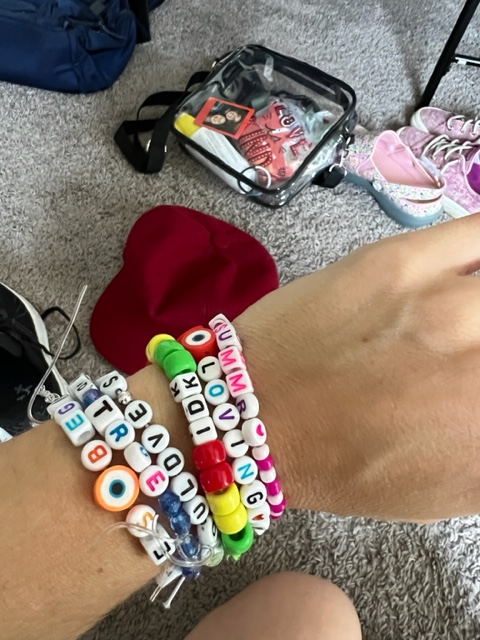
Intro: The end and the beginning: the bracelets

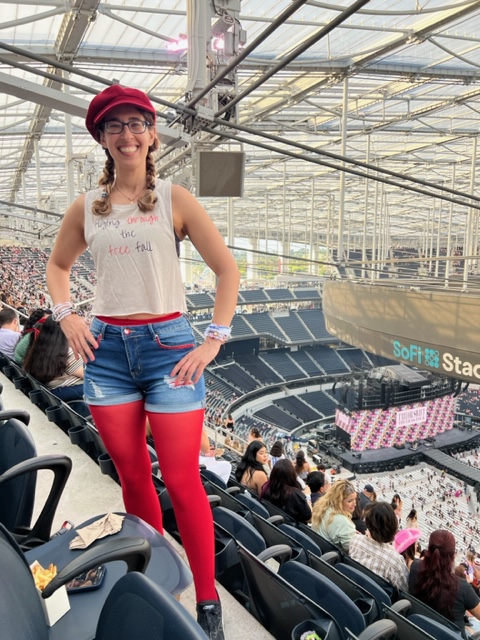
I am writing this with six friendship bracelets jangling on my left hand, only one of which I made for myself — “overdramatic and true” from Lover, which I will eventually give to my Mom, who wanted one. I began with more bracelets, but some were given away in exchange for nothing. My favorite friendship bracelet, “loving you is Red,” was received the day before the concert from a fellow law prof who also attended the concert with her partner, although she had much better seats. I was five rows from the very top of the stadium, which I feared would make me feel disconnected from the concert, but it did not.

My second favorite friendship bracelet was one I procured from a stranger. Exchanges happened in random and symbolic ways. Looking at one girl’s stash, I chose one of the first ones I saw and absolutely loved, which was exceptionally fitting for me. It just says “IDK,” with red, green, and yellow beads, like the traffic lights in Death by a Thousand Cuts that didn’t know if Taylor Swift would be all right.

I was worried initially that exchanges weren’t happening in the fun, open, loving Taylor Swift way I expected, but then they were. For example, some girls complimented my shorts, which friends helped me bedazzle into the word “Archer,” and I bounded up several rows to exchange bracelets with the group of complimenters with them. My outfit was mostly Red Era, because Red is my favorite song (my friend made me a shirt that says “flying through the freefall”), but I had a bit of Lover, my favorite album.

Folklore is my second favorite album, and I was certainly not going to take the inevitably-needed bathroom break during that set, but luckily the friend I went with agreed to go earlier, during Enchanted. I barely knew the woman who became my friend and concert-mate, a fellow aerialist from my dance studio in Ohio, when I put up posts on social media asking if anyone wanted to see the Eras Tour with me in Los Angeles. Luckily for me, this woman is the exact opposite of me, and she believes in a form of spiritual mysticism that told her the universe was telling her to do this with me. I can be annoyingly hyper-rational, but she was absolutely my Taylor Swift guardian angel. Indeed, we knew each other so little that she thought that when my friends referred to me as professor, it was a joke, like I know things. We didn’t know each other’s jobs. But we both knew that seeing Taylor Swift in Los Angeles was something we needed to do.

She dressed as 1989, and this was her third Eras concert. She is a dedicated Swiftie. I am unclear as to whether I am a Swiftie. Like the bracelet says, IDK.

Part I: Am I a Swiftie?

I never considered myself a Swiftie. I have long casually liked her music, and the concert reminded me of all these songs I knew the words to from way back when, before Taylor Swift was a phenomenon and psychological puzzle to me, and before her lyrics moved me and changed me and became profound to me in literary ways. Now, songs like The 1 and Cardigan, and their interesting juxtapositions, have altered my perspectives on ideas like love. But I knew all the words to I Knew You Were Trouble from a time when her lyrics were just fun and catchy, and the concert reminded me of this past self, as it did for many of us. A girl sitting two seats away from me, who was sitting by herself and was crying for much of the concert, also went through phases of feeling differently about Taylor Swift. Apparently, it was not cool to like TS when she was in high school, and then it became cool again.

A few months ago, for personal reasons, I began listening to Taylor Swift much more. I became fascinated by her life and story, like many, and I listened multiple times to the outrageously excellent podcast, Every Single Album; Taylor Swift. I learned about her personal and musical evolution in ways that deepened my peripheral, glossy understanding of these topics. I wanted to know more and more. I got into the lore. I got into the cultural phenomenon. Her life is a show I was delighted to watch, and that podcast told me that if I really wanted to, tickets were accessible to me. Yes, the price was steep, but I live in Ohio and my favorite food is Kraft Mac and Cheese. I decided to treat myself.

Here’s the thing. I never wholeheartedly like anything, and certainly nothing as complex as Taylor Swift. Her songs are gorgeous and interesting and vivid, but she’s not like Bob Dylan or Simon and Garfunkel to me. I would describe her as talented, but not a genius, and I worry that we dilute society’s understanding of genius by the comparisons being made. She is not generally novel in a profound way. [Edit- many of her songs have a lyrical originality that is perspective-shifting and life-altering, and she certainly captures the inner life and emotional experience of many people, and even beautifully captures her own existence in a way that communicates something remarkable and previously ineffable and makes us all more connected to ourselves and to her.] She is a weird mix of super talented/genetically gifted/uncommonly hardworking, and also the everyman/everywoman. Whatever magic she has that got basically everyone around me at the concert to almost effortlessly know all the lyrics to every one of her songs, including the surprise songs, I wouldn’t consider it to be the kind of thing that animates the question “how many roads must a man walk down before you can call him a man,” or even “hello darkness my old friend.” [Edit: that said, I could listen to Taylor Swift music nonstop potentially forever, over and over.]

And here’s the other thing. I like Jake Gyllenhaal. I dislike that she dug up a relationship ten years dead knowing that the Internet would bully him. She seems like a good, caring person, but sometimes she appears very thoughtless. I dislike the kind of feminism that has women feeling like every loss is a slight due to their gender. I don’t like The Man and don’t agree with it. I don’t find her often positioning herself as the victim empowering.

Does calling oneself a Swiftie require worshipping her in cult-like fashion? Like the bracelet says, IDK. But a Lyft driver told me that traveling 11 hours to see her, due to plane delays, meant I was one.

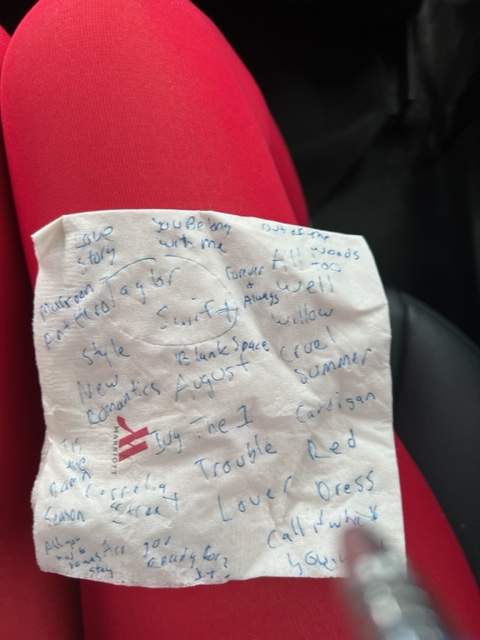
A different Lyft driver, a lovely Egyptian-American man who has long lived in Los Angeles, didn’t know who Taylor Swift is, and he asked for me to write her name on a napkin. I included a number of her songs, and my professor friends with the good seats added other necessary ones to represent her oeuvre via text. This list-making was on the way to the concert, and it certainly re-invigorated my view of how exceptional she is as an artist, because I loved all these songs and many more.

Part II: The Concert

The actual concert was some combination of group singalong and dance party, people-watching spectacle, and awe-inspiring gaze at a famous person whose personality and career I find fascinating to the point of potential starstruck obsession. I don’t think I got the concert-euphoria amnesia described by some, but reviewing the sporadic videos I captured later – I wanted to also be quite present and not on my phone – made me appreciate the experience even more, so memory definitely clouds my understanding of the event.

The opening acts of Gayle and Haim were fantastic, by the way. The countdown to Taylor was exciting, and we made friends with people around us. I imagine Los Angeles has a slightly less hometown feel than other places, but it was still very open and friendly. SoFi is an incredible stadium, and I felt totally part of the action.

I didn’t memorize the setlist on purpose, but people kept cuing me to what was coming next, and when it was about to be The Archer, my friend signaled, and I noticed from the first few notes and became incredibly excited.

Let me just show you Archer, one of my favorite songs and the word written on the back of my shorts.

Easy they come, easy they go…

I wanted to follow Taylor like a sparkly princess around the stage but mainly watched the giant screens and the joyful people around me, all dressed as different eras. Some performances were so emotional to me that I had spontaneous welling up, like Marjorie, which made me think of my own, extremely different, grandmother, and like My Tears Ricochet, to which I attach personal meaning. Other moments, candidly, felt like a slog. She marches through each number, one by one, sometimes in an almost perfunctory way. I was at the very last concert on the U.S. leg for a while, and she must have been very tired of doing this. It didn’t always feel super fresh, and the concert is long. I was reminded, at times, of how her music, while quite expressive, often lacks soul. She doesn’t have this primal, raw, soulful element I get from Sam Cooke, Aretha, Amy Winehouse, or even Adele. Taylor and I have very different backgrounds, and perhaps different things move us. But she did move me quite a lot, at times. I kept wanting to know where she was on the stage.

Part II.A: Surprise Songs

Many of us knew that New Romantics would be one of the surprise songs. I now like that song in a new way. I do adore the message of embracing love and heartbreak and fighting battles together. Here I am singing.

Baby, I could build a castle…

This was never one of my favorite songs, but now it is.

New Year’s Day is not a song I love, and I was a bit heartbroken she didn’t play Cornelia Street as the second surprise song. I now have read all the Karlie Kloss lore and am of two minds about it.

Part II.B: The Release of 1989, Taylor’s Version

One reason I may not be a true Swiftie is because I am not that invested in her re-leasing albums to own her masters. It feels a bit gimmicky, another way to position herself as the underdog when her original album made her who she was, which is (deservedly) incredibly rich. I think she’s also had new opportunities to purchase her masters, but now she’s committed to the project, which doesn’t feel entirely genuine. I like listening to the old versions, and I don’t love the implied guilt in doing so. I do relish her releases from the vault.

My friend/concert-mate was extremely excited for the announcement that 1989 Taylor’s Version is coming, but I don’t love 1989. I love Taylor in fiery love, or Taylor in contemplation, which is why Lover and Folklore are my favorite albums and Red is my favorite song. I don’t love the bops as much – some of Red excepting. So, this wasn’t the moment for me that it was for others, but I do look forward to the October release.

Conclusion: The end and the beginning, again

I ultimately didn’t want the concert to end, especially not how it did. I was hoping for something extra for those of us who chose her last U.S. concert, before she shockingly announced even more U.S. dates. I wanted something more. Another surprise song. A nod. Another piece of her. I am not sure what. Perhaps part of her appeal is that she always leaves her fans wanting more of her, so accessible yet so distant.

I left the stadium in a daze, with my voice hoarse from the 8 minutes of screaming and cheering after Champagne Problems, which did not get old. It did not get old. It became a ritual to cheer for her after that song, and New York and Los Angeles had the longest cheers, and I wanted to break the record. It was such a release to cheer for so long. We were cheering for her, but we were cheering for all of us.

The next morning, at first I felt somehow disappointed, as maybe it wasn’t worth the money and travel and sleepless nights on a friend’s pullout couch and maybe the adulation was unearned. Then I watched my videos again and received another high from that unparalleled experience at SoFi. Thank you, Taylor Swift and the Swifties, for showing me incredible things.

The high was worth the pain.

It Would Be A Catastrophe For Legal Education for Law Schools to Go Test Optional

The American Bar Association is still considering whether to allow law schools to go test-optional for their admissions decisions.  A test-optional regime does not mean law schools must stop requiring the LSAT (or the GRE) for law school admissions, but this is a likely result.  Although many law school deans are against the move to make law school test optional, they will feel compelled to stop requiring the LSAT so that their law schools can compete with other law schools who will not mandate the test.  Law schools need to attract students, and a move to test-optional is a (misguided) way of making students more attracted to law school.  Having been in legal education for a decade now, I feel quite strongly that going test-optional will be harmful for law students, for law school, for the practice of law, and for education in general.

The LSAT measures skills that are important for law students and lawyers, and for improving nuanced critical thinking, such as reading comprehension, logical reasoning, and analytical reading.  These skills can be developed with practice, and one way to amplify students’ readiness for law school is to require them to study seriously for the LSAT, where they will learn about logical fallacies and, my favorite, the contrapositive.  (I did not take an LSAT course, but even buying a not super expensive study book and ordering a few practice tests greatly improved my analytical skills.)  Students who come to law school having a base level of these skills will be much more successful, and professors can teach at a higher level for all of their students.

Further, because the test is so well adapted to reading and analysis, LSAT scores are quite correlated with law school performance and bar passage, especially at the extremes.  Below a certain LSAT score, a student is very unlikely to pass the bar, required in most states to practice law (for good reason; lawyers have a tremendous responsibility to their clients — criminal and civil — and to the courts, to perform their jobs competently).

The reasons proponents give for abolishing the LSAT (or another standardized test) requirement do not hold up to scrutiny.  First, it is true that no one test can measure a student’s aptitude, potential, or readiness.  But this is why the LSAT is used only in conjunction with other metrics.  Perhaps more significantly, there is the important issue of equity. In the aggregate, certain groups perform worse than others on the LSAT, by a significant margin.  Abolishing a good test because it yields inequitable results is a willful blindness that will compound the social problems going test-optional is trying to solve.  The inequities in education and resources that lead to diverging test results will continue to manifest throughout law school.  The problem is not the test.  To remove a standardized indicator that often helps disadvantaged students – who don’t have fancy college degrees or recommendation letters – will mean a much greater risk that law students who are unlikely to pass the bar or succeed in law school (unless the demands of law school are greatly reduced) will assume a great deal of debt as schools become needier for student enrollment. 

Equity cannot be the only value that drives decision-making.  For lawyers, who should be better at balancing interests, this seems like a myopic and scary move.  No one benefits if there isn’t a standardized way to distinguish students with greater need for academic support and those whose critical thinking and reading skills are already well developed.  No clients benefit if lawyers cannot serve them well.  This may ultimately end up creating far greater social inequities. 

Besides the LSAT, law schools could look at grades, which are heavily inflated as undergraduate institutions lower demands of rigor in order to attract students, essays, or perhaps interviews.  Any of these metrics will be far more subject to bias and will not give students the benefit of the learning they gain from studying for the LSAT.

I am writing this mostly as a warning, because I love the law, I love teaching, and I believe in students’ potential, if we challenge them and prepare them well enough.  We should not let the American Bar Association, in its single-minded zeal, create a race to the bottom where we all lose.