Richard Spencer’s Biceps (and why his legal ability to maintain them matters)

Can’t a neo-Nazi go to the gym in peace? This is not a rhetorical (nor a sarcastic) question, but one that implicates our civil rights, civil liberties, and cultural values and meta values.  The legal answer is that a gym may generally terminate the membership of one of its patrons for political reasons.  However, the gym also has the prerogative to continue the membership.  No gym can be required to terminate Spencer’s membership.  The cultural answer, I hope, is that some gyms do allow Richard Spencer to continue to use their facilities.

Continue reading “Richard Spencer’s Biceps (and why his legal ability to maintain them matters)”

Resolution of Timothy Piazza’s Death Cuts to the Heart of Our Legal and Social Identity


The factual details of a Penn State student’s death, after he deteriorated for twelve hours from skull and spleen injuries before his fraternity brothers called an ambulance, are haunting.  Resolution of the legal and social issues is more complicated.  How judges and juries handle this case will ultimately require determinations of who we are as a society, what choices we have, and how much we should be punished when we fail others in the most serious way.

There are no simple answers here, mostly hard questions.  But we must see clear to avoiding overly punitive measures while confronting the dark pathologies that contributed to Timothy Piazza’s death.  The gruesome, unforgettable images from this case have caused me to reconsider my own views on interlocking issues such as the role of the criminal law in shaping social behavior, anti-hazing measures, video surveillance, and personal responsibility.

Continue reading “Resolution of Timothy Piazza’s Death Cuts to the Heart of Our Legal and Social Identity”

The Resistance and the First Amendment


trumphotel_emoluments_timjhogan


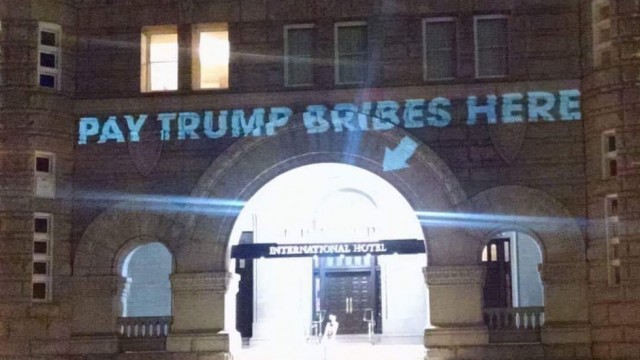
Yesterday, artist Robin Bell projected the text of the Emoluments Clause of the Constitution onto President Trump’s International Hotel in D.C., along with the message “Pay Trump bribes here.”  The hotel staff asked Bell to remove the projection, and he did, for the fifth time.  Last week, reporter Dan Heyman was arrested for “willful disruption of government processes.”  Heyman’s attempts to ask Health and Human Services Secretary Tom Price a question about health insurance for victims of domestic violence were categorized as “aggressively breaching” Secret Service agents.  (Heyman was not asking questions of Price at an organized news conference, because Secretary Price was not giving the media access to his trip to the West Virginia state Capitol.)  Before Trump was elected President, people vandalized Trump campaign signs, some committing other crimes in the process.

Although many actions of protest against Trump involve peaceful speech that is protected by the First Amendment, others are clearly unprotected, disruptive conduct.  Light projections onto others’ property are likely not protected speech, although whether they constitute a trespass or a nuisance divides the courts.  Vandalism is a criminal act.  Not only is vandalism not protected speech as against government restriction, but vandalism against campaign signs is used to forcefully negate the protected, political speech of private individuals.  Interfering with the duties of Secret Service agents, even in the name of journalism, is not protected activity, although Heyman’s actual interference here is questionable.  The President should give reporters extra leeway, if not in the name of actual First Amendment rights, then for free speech values.  (If the President is targeting reporters to silence them, that would likely be unconstitutional.)

What many are celebrating is, ultimately, unprotected activity designed to either protest Trump or expose the misdeeds of his administration.  The question then becomes:  how should we treat this activity, given our current political climate?  The praising of some of this activity requires both an altered perspective on First Amendment rights and on the exigencies of the need to resist President Trump.  Below is just a word of caution on both fronts.

Continue reading “The Resistance and the First Amendment”

Insurance Final Exam

If you miss law school exams, or are yearning to see what’s covered in an Insurance class, please enjoy my final exam for Spring 2017.  I will not post answers to the exam, but if you take the exam and write me separately, I will send you answers.

Insurance Final Spring 2017

Legal Frameworks and Free Speech Lenses in The Handmaid’s Tale

If you’re not watching The Handmaid’s Tale, you should be.  The Hulu series based on Margaret Atwood’s book (which I haven’t read, so I am watching fresh) does not rise to the level of profundity, creativity, grace, or elegance of the famous dystopian novels 1984 and Brave New World.  However, so far, the series has sophisticated writing, masterful acting, poetic filming, and powerful moments of tension and revelation.

A main function of dystopian fiction is to present an exaggerated form of some aspects of our society, so we gain new perspective.  As the series notes, people eventually habituate to rules and customs that seem strange at first.  Dystopian fiction forces us to reexamine aspects of our government and our culture to which we have become habituated.  The Handmaid’s Tale should be viewed with an eye to understanding our culture’s current pathologies, although its relevance to our current political climate has been overstated.

For a viewing experience more nuanced than “sexism is bad,” when you watch the show, attune yourself to issues of (1) choice versus government control and (2) language as both oppression and subversion.  Both themes have strong implications for First Amendment rights.

Continue reading “Legal Frameworks and Free Speech Lenses in The Handmaid’s Tale”

Partisans Versus Contrarians: The New York Times, The Harvard Business Review, and the Orwellian Distortion of the Free Speech Debate on College Campuses

Because I love a good dichotomy, I tell my students that the world is divided into two types of people: partisans and contrarians.  Partisans feel greater certainty about their own views; they enjoy congregating around others who share those views; and they don’t scrutinize the views or tactics of their partisan cohort the way they scrutinize those who disagree with them.  Contrarians, by contrast, rebel against views that have achieved some measure of prominence; they enjoy picking apart the dominant paradigm; and they fear congregations sharing an orthodoxy of opinion.

The partisans, unfortunately, have gained ascendance in academia – and with that has come a redefinition of the nature of free speech and intellectual engagement.

Continue reading “Partisans Versus Contrarians: The New York Times, The Harvard Business Review, and the Orwellian Distortion of the Free Speech Debate on College Campuses”

The FCC’s Investigation of Stephen Colbert Likely Violates The First Amendment

After Stephen Colbert made a joke on The Late Show about President Trump performing fellatio on Russian leader Vladimir Putin, many across the political spectrum took to social media to call for CBS to fire Colbert.  Colbert remains unapologetic about the joke.  He stands by his right to make vulgar jokes, even to criticize the President, and noted in a later monologue that “anyone who expresses their own love in their own way is to me, an American hero.”  (He did, however, say that some of his terms were “cruder than they needed to be.”)

Continue reading “The FCC’s Investigation of Stephen Colbert Likely Violates The First Amendment”

My Last Class at ONU and My Future as a Law Professor

Today, I taught my last class as a professor at Ohio Northern University.  At the end of June, I will be moving to Dayton to become a professor at Dayton Law School.  Just like last year, when I transitioned from being a Climenko Fellow at Harvard Law to an assistant professor at ONU Law, I would like to share some reflections and hopes for the future.

Continue reading “My Last Class at ONU and My Future as a Law Professor”

Blurred Lines and Feminist Rhetoric

Philosophy professor Rachel Tuvel has had a bad few days.  Hypatia, a journal of feminist philosophy, published her article “In Defense of Transracialism.”  As the name suggests, her article considered whether transracial identity should be given the same status as transgender identity.  (My short, somewhat reflexive answer would be “No,” but this is a question philosophers should consider.)  Academics then unleashed the most heated, brutal criticism against her and her methods – calling her work “violence” for using phrases like “male genitalia” and deadnaming Caitlyn Jenner, who also alternatively refers to her former name.  Hypatia, which accepted the paper after anonymous peer review with several referees, ultimately apologized for the article and claimed it should never have been published.

Some academics have come to Tuvel’s defense.  Philosopher and law professor Brian Leiter claimed the open letter and Hypatia’s apology are defamation.  I would not go this far.  The statements against Tuvel were based on opinion and judgment that did not imply the existence of untrue, defamatory facts.  To stifle discourse by threatening a lawsuit would be to engage in even more extreme forms of censorship than the feminist philosophers trying to ruin Tuvel’s career.  I would, however, say that this event illustrates the crisis of blurred lines in feminist rhetoric (and in academic and political discourse more generally).

Continue reading “Blurred Lines and Feminist Rhetoric”