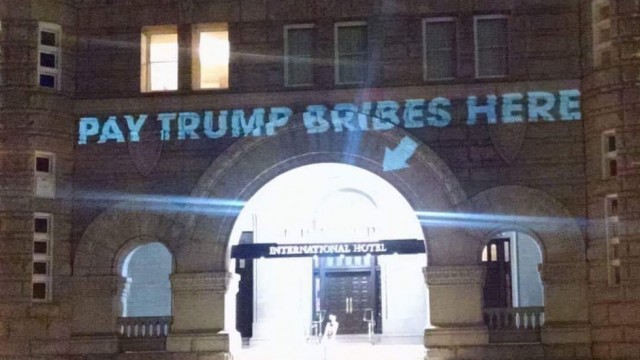
Yesterday, artist Robin Bell projected the text of the Emoluments Clause of the Constitution onto President Trump’s International Hotel in D.C., along with the message “Pay Trump bribes here.” The hotel staff asked Bell to remove the projection, and he did, for the fifth time. Last week, reporter Dan Heyman was arrested for “willful disruption of government processes.” Heyman’s attempts to ask Health and Human Services Secretary Tom Price a question about health insurance for victims of domestic violence were categorized as “aggressively breaching” Secret Service agents. (Heyman was not asking questions of Price at an organized news conference, because Secretary Price was not giving the media access to his trip to the West Virginia state Capitol.) Before Trump was elected President, people vandalized Trump campaign signs, some committing other crimes in the process.
Although many actions of protest against Trump involve peaceful speech that is protected by the First Amendment, others are clearly unprotected, disruptive conduct. Light projections onto others’ property are likely not protected speech, although whether they constitute a trespass or a nuisance divides the courts. Vandalism is a criminal act. Not only is vandalism not protected speech as against government restriction, but vandalism against campaign signs is used to forcefully negate the protected, political speech of private individuals. Interfering with the duties of Secret Service agents, even in the name of journalism, is not protected activity, although Heyman’s actual interference here is questionable. The President should give reporters extra leeway, if not in the name of actual First Amendment rights, then for free speech values. (If the President is targeting reporters to silence them, that would likely be unconstitutional.)
What many are celebrating is, ultimately, unprotected activity designed to either protest Trump or expose the misdeeds of his administration. The question then becomes: how should we treat this activity, given our current political climate? The praising of some of this activity requires both an altered perspective on First Amendment rights and on the exigencies of the need to resist President Trump. Below is just a word of caution on both fronts.
Continue reading “The Resistance and the First Amendment” →

 In A Crowded Theater